EASTHAM HOUSE HISTORY
Eastham House’s location at the confluence of the Kanawha and Ohio Rivers has always been a place where worlds met and mixed: Indigenous & European, wild & cultivated, enslaved & free.

In a country of steep ridges and narrow hollows, where large-scale farming was largely impossible, the rich soils fed by these rivers have been shaped by thousands of years of human intention. The peoples of the Woodland period walked the bottomlands as skilled stewards, gathering and managing wild plants. Then, sometime around 1000 CE, maize arrived — carried northward from Mexico in a slow migration of seeds and knowledge — and the Fort Ancient people transformed the alluvial floodplains into gardens.
Corn, beans, and squash rose together in the elegant symbiosis of the Three Sisters, each plant sustaining the others.

In 1770, a young George Washington passed through on a surveying expedition and claimed the land, as was customary of the era. When he died, it passed to his nephew Bushrod Washington, who eventually sold it to a Revolutionary War veteran named George Eastham, and the land acquired the name it carries today.
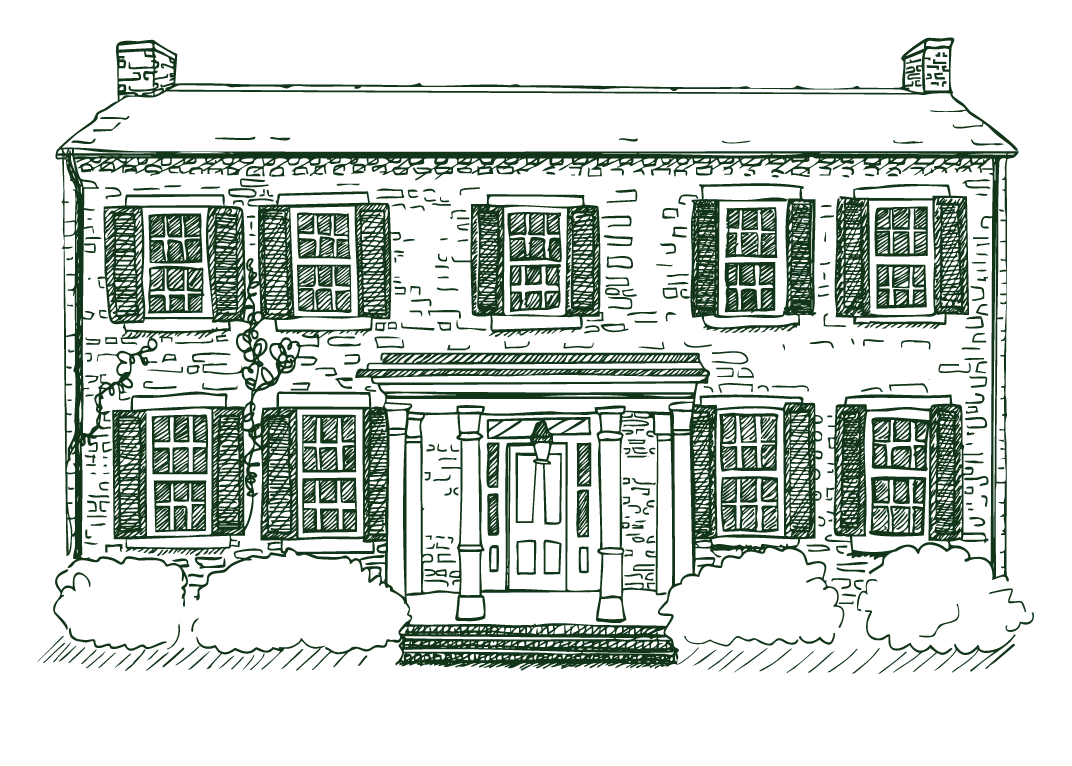
Two generations later, Albert Gallatin Eastham built Eastham House, also known as Fairview Plantation, using enslaved labor. The cultural landscape of Fairview Plantation was experienced very differently depending on where one stood within it. For the enslaved Black men and women who labored here, the symmetry and grandeur of the mansion was not an expression of their world but a monument to their exclusion from it. Today, the Eastham House remains as one of the best examples of Greek Revival architecture in West Virginia–a distinction that carries both aesthetic and moral weight.
Until West Virginia broke from Virginia during the Civil War, Eastham House sat on the Confederate side, within striking distance of Ohio. The river, visible from the fields, became a horizon charged with desperate meaning. The town of Point Pleasant, just downstream, harbored abolitionists and was connected to the Underground Railroad.
The property would remain in the Eastham family until 1890. Throughout the rest of the 19th century and into the 20th, the house passed through various owners and caretakers. In 1943, a modernization of the mansion’s interior spaces was undertaken. The carriage house, which serves as a garage and an apartment, was constructed in the 1970s and designed to match the architecture of the house. In 1980, another restoration of the house occurred, including reconstruction of badly damaged portions. In 1988, Eastham House was listed on the National Register of Historic Places.
What makes Eastham House remarkable is not simply its architecture or its agricultural setting or its famous surveyor, but the full weight of all of it together. The centuries of human striving, cultivation, conflict, and survival are concentrated in one rare and fertile bend in the river.